
What Your Body Is Trying to Tell You
Let’s start with a small confession: for years, I treated my body a bit like a toddler in a supermarket. Loud, demanding, occasionally embarrassing, and best ignored until it stopped making a fuss.
I was diagnosed with gluten and lactose sensitivity at 35. Yep, it took me that long to realise the fuss was the point. The unexplained daily tummy cramps, the “fast transit”, the oh-so-regular tummy bugs and colds, the skin issues, just to name a few. Your body is not being dramatic. It is running a constant, quiet, remarkably sophisticated messaging service, and most of us never got the training manual. So we skim over the messages, or delete them unread, and then wonder why the notifications get louder.
Today we’re not busting any myth, or throwing scary statistics around. I just want to invite you to get curious about what your body is trying to tell you (has probably been saying for a while), and what that might have looked like for you.
What is body awareness, really?
“Body awareness” can sound a bit ‘out there’, so let’s make it practical. It simply means noticing physical signals (like hunger, energy, digestion, mood, sleep) and treating them as information, rather than just noise to be overridden.
Think of it as being a good scientist about your own life. A scientist doesn’t shout at the data for being inconvenient. They write it down, look for patterns, and form a sensible guess. That’s the whole skill. No pendulum required.
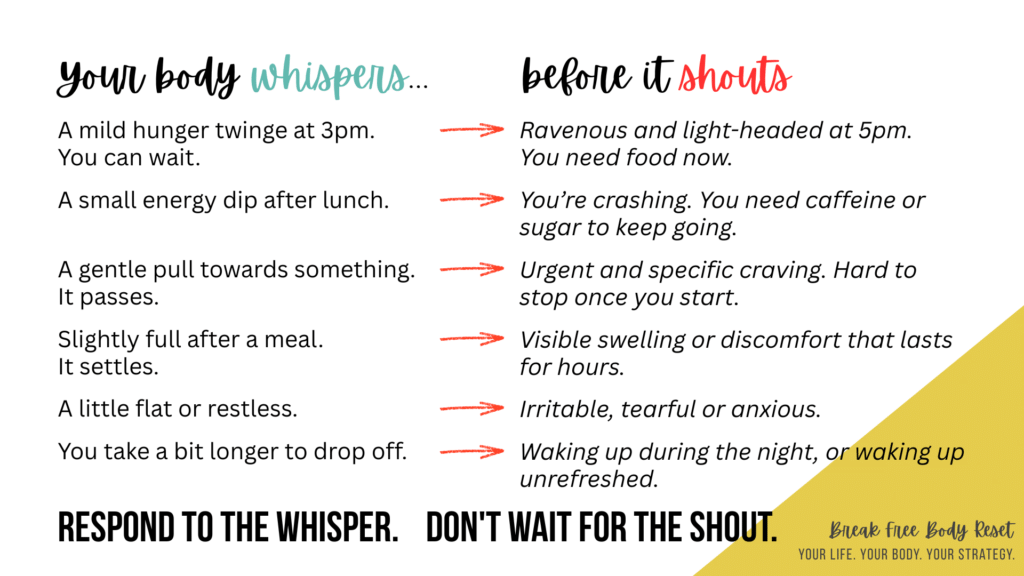
And here’s the useful bit: most signals start small. A whisper, not a shout. That matters, because whispers are far easier to work with. If we listen, that is. Like, a slight dip in energy at 3pm can be answered with a snack, a glass of water or a five-minute walk. A full-blown crash at 5pm, followed by a raid on the biscuit tin and a snappy evening with the family, is a much bigger job to deal with.
So the aim of this post is be gentle and kind to yourself, and to help you hear the whispers a little sooner. Let’s go through some of them one at a time, starting with the most obvious one.
Hunger
It’s 1.30pm. You’ve been in back-to-back calls/meetings/classes since nine. You suddenly realise your hands are slightly shaky, you’re snappy with a colleague who did nothing wrong, and you’re too frazzled to decide what to have for lunch. Ten minutes ago, you didn’t even feel hungry.
That, right there, is a late hunger signal. Real hunger usually starts as a gentle nudge: a slight emptiness, a bit of distraction, a thought of food that keeps popping up. If the nudge gets ignored, it escalates into irritability, poor concentration and that slightly frantic “I’ll eat anything” feeling.
Hunger is driven partly by hormones such as ghrelin, which rises before meals and falls after eating. It’s a perfectly reasonable system. The problem is that years of dieting, skipped meals and “I’ll eat when I’ve finished this” teach us to talk over it.
Try noticing:
Before your next meal, rate your hunger from 1 (not at all) to 5 (ravenous). No changes needed. Just notice the numbers. Many women are surprised to find they habitually go on a “see-food diet” at a 5, when a 3 would have been handled nicely.
Cravings
9pm. The kids are finally in bed, the kitchen doesn’t look like something exploded in there anymore, and you are standing in front of an open cupboard, not hungry exactly, but absolutely certain that something salty or sweet is required.
A craving is not the same as hunger. Hunger is general and flexible: most foods will do. A craving is specific and insistent: it has to be that food. Now.
Cravings often turn up when we’re tired, stressed or under-fuelled. In a controlled study, women who were short on sleep reported stronger hunger and food cravings, and chose larger portions, than when they’d slept well. In other words, the biscuit tin isn’t the culprit. Sometimes the culprit is last night’s four hours of sleep.
That doesn’t mean every craving must be obeyed, or that every craving must be resisted. It means a craving is worth a moment of detective work.

When only cookies will do…
Try noticing
Next time you’re in front of the cupboard, ask three quick questions.
- Have I eaten enough today?
- Have I slept well/enough last night?
- What am I actually feeding: tiredness, boredom, irritability, [add here]?
Then decide what to do. The point isn’t to say no. The point is to know why.
Energy
It’s 3.15pm. Your eyelids feel heavier. You’re on your third cup of coffee and have been staring at the same email for the last 10 minutes, and the thought “I just need a sweet pick-me-up” arrives fully formed.
Energy is one of the most honest signals your body offers, because it’s very hard to fake. A steady stamina throughout the whole day usually reflects adequate sleep, regular nourishing meals, and a nervous system that isn’t permanently on high alert. A sharp mid-afternoon slump is often your body waving a small flag about one of those things.
Please note the word “often”. Sometimes an energy dip is just the natural dip in your daily rhythm. It’s worth noticing, not dramatising.
Try noticing
When your energy dips, think back to what happened in the three hours beforehand. Skipped breakfast or lunch? Back-to-back meetings? A very beige meal? After a week or two, you’ll probably spot your own pattern.
5 Reasons Why Weight Loss Feels So Hard
And what to do about it
Bloating
You get dressed in the morning and everything fits nicely. By 4pm, you’re discreetly undoing a button under your desk, wondering why it feels like you’ve swallowed a small balloon.
Bloating has a reputation as a mystery, or a personality flaw, or something to be fixed with some fancy herbal tea. Usually it’s more mundane. It’s your gut giving feedback on something: the food itself, how fast you ate, how stressed you were (<- this is real), or how much air came along for the ride.
Digestion is closely tied to the nervous system, which is why a perfectly good meal eaten in a rush, standing up, while answering messages, or while having an argument can sit very differently with you compared to the same meal eaten at a peaceful table.
Persistent, painful or worsening bloating is worth a chat with your doctor, particularly if it comes with other changes. Everyday, come-and-go bloating is often a pattern waiting to be spotted.
Try noticing
Note down when it happens, what you ate, how fast you ate, and how your day was going. Patterns tend to show up faster than you’d think.
Mood
You wake up flat for no obvious reason. Nothing’s wrong, exactly. You just feel a bit low, definitely short-fused, and slightly less patient with everyone than you’d like to be.
We tend to file mood under “mental” and digestion under “physical”, as if they lived in separate buildings. They don’t. Same building, different floor. Your gut and brain are in constant two-way communication, often called the “gut-brain axis”, which is one reason why stress can upset your stomach and why your gut can influence how you feel.
This doesn’t mean every low mood is dietary. Life is complicated, and some seasons are simply heavy. But mood belongs on your list of signals, alongside hunger and energy, not in a separate folder marked “just me being dramatic”.
If low mood is persistent or affecting your daily life, please speak to your doctor or a mental health professional. Noticing is not a substitute for support.
Try noticing
On a meh day, run a gentle check:
- How did I sleep?
- Have I eaten properly?
- Have I moved from my desk at all?
- Have I been on my own too long?

Sometimes your mood is also a signal.
Sometimes there’s a small thread worth following.
Sleep
You go to bed at 10.30pm, but you scroll until 11.45pm. You wake up at 3am thinking about something that is already on your To-do list. By morning you’re exhausted, and wondering why you crave bread at 10am.
Sleep is the signal that quietly affects all the others. In a small experimental study, short sleep raised ghrelin (the hunger hormone) and lowered leptin (the fullness hormone), and people reported feeling hungrier the next day. So the 10am craving for toast is not a moral failing. It’s chemistry.
This is also a two-way street. Stress and blood sugar swings can disturb sleep, and poor sleep makes both harder to manage. A bit of a circular argument, really.
Try noticing
Rather than aiming for “perfect sleep” (a sure fast-track to lying awake worrying about sleep), simply note the time you went to bed, roughly when you fell asleep, and how you felt the next morning. Three lines is plenty.
On the days when you wake up feeling refreshed, notice what happened. Rinse and repeat.
The food diary, reimagined
Now, we’ve all tried food diaries before. They lasted four days, ended in guilt, and are now buried in a drawer next to a half-used bullet journal.
I get it. Food journals have a slightly grim reputation, tangled up with calorie counting and self-policing. So let’s give them a makeover: think of a food diary as a lab notebook for an experiment where you are both the scientist and the subject.
The evidence for self-monitoring is solid: in a well-known weight-loss maintenance trial, people who kept daily food records lost about twice as much weight as those who kept none.
But here’s my spin: the real gift of a journal isn’t accountability, it’s information. You can’t change what you don’t see. Turning vague feelings (“I’m always tired”, “I’m always bloated”) into a visible pattern is what makes change possible.
A useful entry has just five columns:
- What I ate & drank (and roughly when)
- Hunger before (1 to 5)
- Fullness after (1 to 5)
- How I felt an hour later (energy, mood, digestion)
- Anything else going on (stress, sleep, cycle, weather, chaos)
No calories. No good or bad. No grading.

Discover what your body is trying to tell you
If you miss a day, you haven’t “failed” the experiment. Scientists call that “missing data” and carry on regardless.
When Your signals feel quiet, or confusing
Your partner asks, “When do you want to have dinner?” and your honest internal answer is a blank. Not because you’re being difficult, but because you’ve spent so long ignoring your hunger signals that you’ve lost track of what it actually feels like.
A quick word for anyone reading this thinking, “But I genuinely can’t tell when I’m hungry or full.”
That’s more common than you’d think, especially after years of dieting, rigid meal plans or eating around other people’s schedules. When we override a signal often enough, it becomes fainter, or at least harder to interpret. Your body hasn’t stopped sending it. It’s more like a radio station that’s been left slightly off.
The good news is that this skill comes back with practice. Start small: one meal a day, one question, no pressure to get it “right”. A slow, curious approach works far better than trying to decode everything at once.
And if your signals feel very muddled, or you find that noticing them brings up anxiety or distress, please don’t push through alone. A doctor, nutritionist or coach can help, and there’s no prize for doing this the hard way.
Learning to notice instead of ignore
None of this asks you to become anxious about every twinge. In fact, it’s the opposite: we’re aiming for a calmer, more curious relationship with signals that are already there, all day, every day.
Your body whispers before it shouts. The gentle dip, the specific craving, the button undone under the desk, the flat morning. These are the whispers. Ignore them for long enough and, understandably, your body raises its voice.
You don’t have to fix everything this week. You only have to start listening a little earlier than you did yesterday.
Want a bit of help identifying which foods you love, but don’t love you back?
Download my free guide, “5 Foods In” for a quick’n easy way to upgrade your diet. Family-friendly and all.
References
Chia-Lun Yang, Jerry Schnepp, Robin M Tucker. “Increased Hunger, Food Cravings, Food Reward, and Portion Size Selection after Sleep Curtailment in Women Without Obesity,” NCBI (PMC): https://www.ncbi.nlm.nih.gov/pmc/articles/PMC6470707/
Maureen Salamon. “How the gut-brain connection influences mood”, Harvard Health Publishing: https://www.health.harvard.edu/digestive-health/how-the-gut-brain-connection-influences-mood
Katherine Harmon. “How Slight Sleep Deprivation Could Add Extra Pounds”, Scientific American: https://www.scientificamerican.com/article/sleep-deprivation-obesity/
Hollis JF, et al. “Weight Loss During the Intensive Intervention Phase of the Weight-Loss Maintenance Trial,” American Journal of Preventive Medicine (2008): https://pubmed.ncbi.nlm.nih.gov/18617080/