Why Can’t I Lose Weight After 45? (Even Though Nothing Has Changed)
If you’ve ever typed some version of “Why can’t I lose weight after 45” into Google at 11pm, sitting on the edge of your bed, wondering what on earth happened to your body, you are nowhere near alone. It’s one of the questions we get asked most often, by women who’ve done everything “right” for years and are now watching the number on the scale creep up regardless.
Here’s the thing that I want you to sit with for a moment: nothing has to have gone wrong for this to happen. You haven’t suddenly become lazy, greedy, or undisciplined. The truth is that your body is going through one of the biggest physiological shifts of your adult life, and most of us were never told what to expect, let alone what to do about it.
Let’s unpack what’s actually going on, and, more importantly, what to focus on instead of another restrictive diet.
5 Reasons Why Weight Loss Feels So Hard
And what to do about it
Why this is one of the most common questions women ask
Weight gain after 40 or 45 is so widely reported and researchers now understand the body composition shift that comes with the “middle-age spread”: an increase in fat mass, a decrease in muscle mass, and a tendency for fat to settle around the middle rather than the hips and thighs. Studies following women through the menopause transition consistently describe this exact pattern regardless of whether their eating or exercise habits have changed at all.
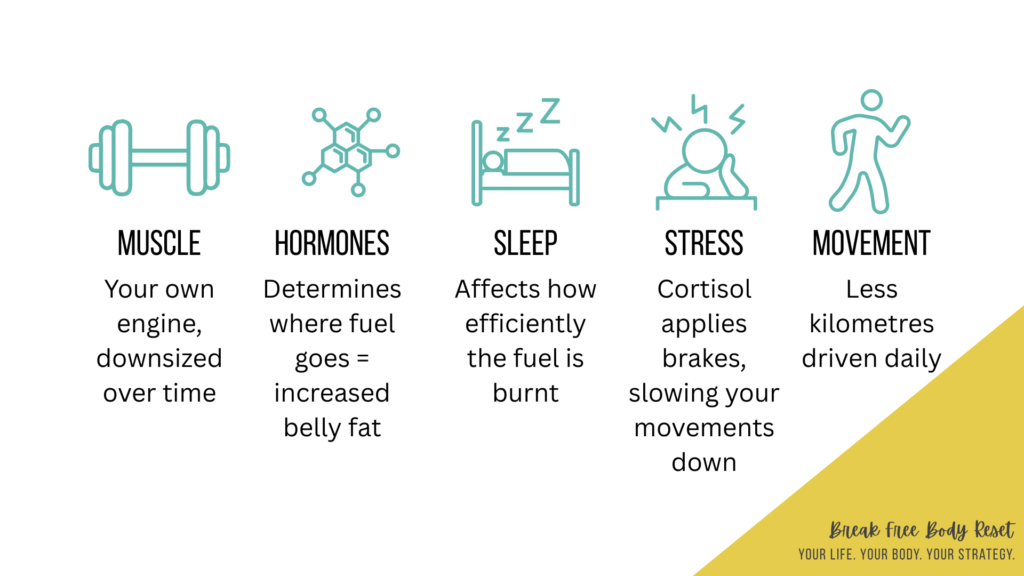
What changes after 40 (muscle, hormones, sleep, stress, activity)
So if we’re still eating and exercising the same, what did change? There isn’t one single culprit here, rather it’s a combination of several things happening at once, which is exactly why “eat less” alone stops working.
1. Muscle mass starts declining
From our late thirties onwards, we naturally start losing muscle, a process called sarcopenia. Muscle is metabolically expensive tissue; it burns more energy at rest than fat does. Research suggests muscle mass drops by about 3% to 8% per decade in women and this loss accelerates specifically during the menopausal transition itself, driven in part by falling oestrogen. Less muscle means a lower resting metabolic rate, which means your body needs fewer calories than it used to, purely to keep the lights on. Nobody warns you about this bit.
2. Hormones shift (and it’s not just oestrogen)
Oestrogen plays a genuine role in how your body metabolises energy and in where the body stores fat. As oestrogen fluctuates and eventually drops during perimenopause, fat storage tends to shift toward the abdomen rather than the hips.
But it isn’t oestrogen alone. Research has found that levels of ghrelin (the hormone that drives feelings of hunger) are actually higher during perimenopause than before or after it. So if you’ve noticed you feel hungrier or less satisfied by meals that used to fill you up, that’s not a willpower issue. That’s biology.
3. Sleep gets disrupted, and disrupted sleep drives hunger
Hot flushes, night sweats and general sleep disturbance are among the most commonly reported symptoms of the menopause transition. This matters more than most of us realise, because sleep and appetite are tightly linked. In controlled studies, even a couple of nights of short sleep raised ghrelin (the hunger hormone) by around 28% and lowered leptin (the fullness hormone) by around 18%, with participants reporting noticeably stronger hunger and appetite the very next day.
Sleep deprivation has also been shown to increase cravings, food reward, and portion sizes selected at meals during subsequent days. Oh, and to add insult to injury, we also become substantially more insulin resistant, so we release more insulin for the same amount of food. More insulin = more fat storage.
4. Stress hormones stay switched on for longer
Cortisol, our main stress hormone, is meant to rise in the morning and taper off by evening. Sleep-deprived or chronically stressed bodies struggle to make that drop happen. Sustained high cortisol encourages the body to store fat around the middle and increases insulin levels (those insulin levels again), raising the risk of insulin resistance over time.
And as you would know, for most women in their 40s, life doesn’t calm down at this exact moment either: it’s often the years of caring for children, ageing parents, and demanding jobs, all at once. With less time spent on those daily self-care activities, like exercise, reflection, or quiet time, the ones that used to do the job of lowering our stress levels.
5. Daily activity often quietly drops
This one’s less about a dramatic change and more a slow fade: less incidental movement as kids need less physical carrying and chasing, more sedentary work, less time and energy for exercise, more time recovering from poor sleep instead of moving. Small shifts, but they add up over months and years.

Why it’s not just about eating less
Put those five things together (less muscle, altered hunger hormones, disrupted sleep, elevated stress hormones, less daily movement) and you can see why simply eating less, the strategy that may have worked at 25, often backfires at 45. Under-eating on top of an already-lower metabolic rate and already-elevated cortisol tends to accelerate muscle loss further, which then lowers your metabolic rate even more. It’s a cycle, not a character flaw.
Why crash diets specifically backfire at this age
This is worth its own section, because it’s one we feel strongly about: severe calorie restriction is one of the worst strategies for a woman in her 40s or 50s, and the research backs this up clearly.
When you cut calories drastically, your body responds as if it’s facing a famine. It protects itself by lowering your resting metabolic rate beyond what would be expected simply from the weight lost. This is a well-documented phenomenon called adaptive thermogenesis, or metabolic adaptation.
Now here’s the kicker: this slowdown doesn’t necessarily reverse once the diet ends; some research suggests it can persist for a long time afterwards, which is part of why so much weight gets regained. Large meta-analysis of popular diets have found that while most produce noticeable weight loss at 6 months, the majority of that weight is back by 12 months.
Very low-calorie diets also cause a disproportionate amount of muscle loss compared with more moderate approaches. Given that you’re already losing some muscle simply due to age and hormonal changes (see point 1 above), a crash diet simply compounds the problem, stripping away even more of the metabolically active tissue you need.
There’s also an appetite side to this that rarely gets talked about: after weight loss, hunger tends to increase far more than metabolism slows down. So crash diets don’t just make your metabolism less efficient: they leave you fighting a stronger hunger drive with fewer physiological resources, at exactly the life stage when your hunger hormones are already less stable to begin with. It’s not a fair fight, and it was never a discipline problem.
Your body isn’t working against you
I want to reframe something here, because the language of “my body is betraying me” comes up constantly in my client conversations, and I understand exactly why. But it isn’t quite accurate.
Your body is doing exactly what a well-functioning body does: adapting to a genuine shift in hormones, sleep and stress. It’s not sabotage. It’s a body responding sensibly to real internal changes, using the same protective mechanisms that have kept humans alive for a very long time. For milleniums, we learnt: lower food intake + high stress = famine, which your clever body is now making sure you survive.
That reframe matters, because how we talk to ourselves about this stage shapes whether we respond with patience and strategy, or with panic and more restriction (which, as above, tends to make things harder).
Small changes have a bigger impact than extreme diets
Given everything above, the single most useful thing you can do at this stage isn’t cutting more calories, it’s protecting and rebuilding muscle, and calming down the stress and sleep side of the equation.
A moderate, sustainable approach, in the form of a modest calorie adjustment paired with strength training to preserve muscle, is consistently shown to hold up better over time than extreme restriction.
Small, sustainable changes also don’t add the extra layer of stress that a strict diet does. And since we now know stress hormones are already part of the problem, that matters more than it might seem.
What to focus on first
If you only take three things from this article, make it these:
Prioritise protein and strength-based movement
Both help protect the muscle mass you have, which supports your metabolism more than any calorie cut will.

Treat sleep as non-negotiable
Even modest improvements in sleep quality can shift hunger hormones back toward balance.
Look at your stress load, not just food
A body under chronic stress will hold onto fat regardless of how “clean” the diet is. Nervous system regulation isn’t a nice extra: it’s a essential part of the strategy.
None of this requires a complete life overhaul overnight. It requires understanding what’s actually happening in your body, and working with it rather than fighting it.
Ready to understand your own body a little better?
Download our free guide, “5 Reasons Weight Loss Feels So Hard” — a plain-English look at why you might not be getting the results you want, and where to start.
References
Zoe.com, “Perimenopause Weight Gain: What You Can Do” — https://zoe.com/learn/perimenopause-weight-gain
Davis SR, et al., “Understanding weight gain at menopause,” PubMed — https://pubmed.ncbi.nlm.nih.gov/22978257/
“Association between menopause-related symptoms and muscle mass index among perimenopausal and postmenopausal women,” NCBI — https://www.ncbi.nlm.nih.gov/pmc/articles/PMC12325020/
“Role of Menopausal Transition and Physical Activity in Loss of Lean and Muscle Mass” (ERMA study), NCBI — https://www.ncbi.nlm.nih.gov/pmc/articles/PMC7290663/
Partial Sleep Deprivation and Energy Balance in Adults: An Emerging Issue for Consideration by Dietetics Practitioners, Science Direct —https://www.sciencedirect.com/science/article/abs/pii/S2212267212013445
“Increased Hunger, Food Cravings, Food Reward, and Portion Size Selection after Sleep Curtailment in Women Without Obesity,” NCBI — https://www.ncbi.nlm.nih.gov/pmc/articles/PMC6470707/
Stanford Lifestyle Medicine, “How Sleep Deprivation Affects Your Metabolic Health” — https://lifestylemedicine.stanford.edu/how-sleep-deprivation-affects-your-metabolic-health/