
Is It Hormones, Menopause… or Something Else?
“Is this just hormones?” is also one of the first questions I get, usually asked with a mix of hope and frustration. Hope, because a hormonal explanation for weight gain feels like it might come with a tidy fix. Frustration, because so many women have already tried the tidy fix and it hasn’t fully worked.
And I understand why: hormones have become the default explanation for almost everything that changes in a woman’s body after 40. Sometimes that’s exactly right. Sometimes it’s only part right. And sometimes, honestly, it’s the wrong answer altogether, and something else entirely is being missed.
This week, I want to give you a balanced, useful answer, because the honest answer is “well yes, but also, probably not entirely.” And blaming everything on menopause can occasionally cost you a diagnosis you actually needed.
5 Reasons Why Weight Loss Feels So Hard
And what to do about it
Hormones do matter
Let’s start here, clearly: hormonal change during perimenopause and menopause is real, measurable, and genuinely disruptive. Perimenopause symptoms can creep up from our late 30s, by the way. Not necessarily the hallmark hot flushes and night sweats, but the less easily diagnosed fatigue, physical and mental exhaustion, irritability, depressive mood, sleep problems, digestive issues, or anxiety. Oh, and that increased belly fat.
The hormonal shifts of perimenopause and menopause are real and well documented. As oestrogen fluctuates and eventually declines, this affects fat distribution, appetite hormones, sleep, mood, and energy. Fat storage tends to shift toward the abdomen rather than the hips, and total body fat tends to rise even without changes to diet or activity. This isn’t a fringe theory. It’s a consistent finding across studies following women through this transition.
Another point worth mentioning, and one that gets lost in most conversations about this: your body composition, meaning the ratio of fat to muscle, can shift substantially during the menopause transition even if the number on the scale barely moves. Two women who weigh exactly the same can be in very different metabolic situations underneath. You could be at the same weight, and still not fit comfortably in your old jeans.
And if you’ve felt like your body is responding differently to the same habits you’ve always used, that’s not in your head. This stage of life changes the internal environment your body is operating in, and that matters.
So no, I’m not here to tell you hormone-related weight gains are a myth. They’re a real and legitimate part of this conversation.
They’re not the only factor
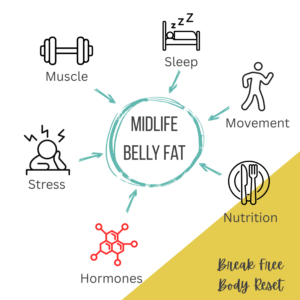
Here’s where it gets more nuanced, and where I think a lot of women get sold a story that’s simpler than the truth. Hormones are one input among several, not the sole author of what’s happening to your body.
A good example: many women assume that starting HRT will reliably shift their weight. A Cochrane review, one of the most rigorous forms of evidence in medicine, looked specifically at this question and found no evidence that oestrogen (with or without progestogen) has any additional effect on body weight beyond what typically happens at menopause, and no evidence that HRT prevents that weight gain either.
I share that not to discourage anyone from HRT (it can be genuinely valuable for symptom relief and long-term health), but because it’s a useful, evidence-based reality check. If hormones were the entire story, correcting the hormones would reliably fix the weight. It often doesn’t, on its own. That tells us something important: other factors are doing real work here too.
A useful way to check this for yourself is to run through the other major players and ask, honestly, how much each one applies to your current life. Not to diagnose yourself, but to notice where your attention has perhaps been narrowly fixed on hormones while other things went unchecked.
Sleep. Ask yourself: am I getting seven or more hours most nights, and is it reasonably unbroken? If the honest answer is no, that alone can drive hunger, fatigue and low mood in ways that mimic a “hormonal” symptom list almost exactly.
Stress. Ask yourself: is my nervous system regularly given a chance to properly rest, or is it running in a low-grade “on” state most days? Chronic stress produces its own hormonal picture, separate from menopause, that can look remarkably similar from the outside.
Nutrition. Ask yourself: am I eating enough protein and fibre to feel genuinely satisfied, or am I under-eating during the day and then struggling with energy and cravings later? Nutrient gaps can produce fatigue, brain fog and low mood that get filed under “hormones” by default.
Movement. Ask yourself: how much of my day involves genuine physical activity, versus simply being busy? A quiet decline in daily movement can affect energy, strength and mood in ways that get attributed to age or hormones rather than to the actual drop in activity.
Muscle. Ask yourself: when did I last do anything that specifically challenges my muscles, rather than just cardio or daily tasks? Muscle loss compounds quietly, and its effects, lower energy needs (read: increased weight gain), less strength, more fatigue, often get grouped in with “the change” instead of being addressed directly.
None of these five is separate from hormones, to be perfectly honest here. They interact with your hormonal picture constantly. And they all influence how much weight you might quietly gain. But they are also, importantly, changeable in ways that waiting for hormones to “sort themselves out” is not. And you have way more agency over those fice aspects of your life.
So if two or three of these honest answers above were “no” or “not really,” that’s genuinely useful information: it points you toward something you can act on this week, not just something to wait out for a few more years.

The danger of blaming everything on menopause
Here’s where I want to be honest with you, because I think this matters more than it gets credit for. Treating menopause as the single, total explanation for weight change carries a real cost.
First, it can lead to a kind of fatalism: “there’s nothing I can do about my hormones, so there’s nothing I can do.” That’s simply not accurate, based on everything above. Sleep, stress, nutrition, movement and muscle are all genuinely modifiable, hormones or no hormones.
Second, it can mean other treatable causes get missed entirely. Thyroid dysfunction, insulin resistance, certain medications, and undiagnosed conditions can all drive weight change in midlife and get waved away as “just menopause” without ever being investigated. If your symptoms feel severe, sudden, or out of proportion to what’s described here, that’s worth a proper conversation with your doctor, not a default assumption.
Third, over-attributing everything to hormones can quietly erode your sense of agency at exactly the moment you need it most. You end up waiting for menopause to “finish” before addressing anything, when in reality, the modifiable factors above are worth working on right now, transition or not.
Keep it balanced
So, is it hormones causing you to gain weight after 40? Often, partly, yes. Is it only hormones? Almost never. The most accurate answer — and honestly the most useful — is that your hormones set the internal weather, but sleep, stress, nutrition, movement, and muscle are what you’re actually building your day around inside that weather. Like, you wouldn’t step outside in a summer dress when the temperature is below freezing, would you? You have meaningful influence over four of those five things, regardless of what your hormone levels are doing this month.
That’s not me minimising what you’re going through. It’s me handing you back some genuine agency, in a conversation that can otherwise feel like it’s entirely out of your hands. So the most useful question isn’t “is it hormones or not?” It’s “given everything that’s genuinely in my control, where do I start?” That’s a much more empowering place to be standing from.
Ready to work with your body instead of against it?
References
Norman RJ, Flight IHK, Rees MCP. “Oestrogen and progestogen hormone replacement therapy for peri-menopausal and post-menopausal women: weight and body fat distribution,” Cochrane Database of Systematic Reviews, summarised via Cochrane, https://www.cochrane.org/evidence/CD001018_hormone-replacement-therapy-has-no-effect-body-weight-and-cannot-prevent-weight-gain-menopause
“From physiology to psychology: An integrative review of menopausal syndrome,” PMC, https://pmc.ncbi.nlm.nih.gov/articles/PMC12635657/
“Association between menopause-related symptoms and muscle mass index among perimenopausal and postmenopausal women,” NCBI, https://www.ncbi.nlm.nih.gov/pmc/articles/PMC12325020/
Stanford Lifestyle Medicine, “How Sleep Deprivation Affects Your Metabolic Health,” https://lifestylemedicine.stanford.edu/how-sleep-deprivation-affects-your-metabolic-health/