why do i keep regaining the weight I lost?
If you’ve lost the same 5, 10 or 15 kilos more than once in your life, I want to say something plainly: that’s not a personal failure. It’s one of the most common, most predictable patterns in weight loss, and there’s a genuine, well-researched explanation behind it.
This is a slightly different question from “why can’t I lose weight?” This is “why do I keep regaining the weight I lost?” And it deserves its own honest answer, because the reasons have far more to do with biology and strategy than with willpower.
It’s also a question that sits right on the edge of mindset, without needing to turn into a full therapy session to answer properly. There’s real, well-documented behavioural research on exactly why regain happens, how one small slip tends to spiral into a much bigger one, and what actually stops that spiral. None of it requires digging into childhood or deep psychology. It just requires understanding how restriction, rules and self-judgement interact, because once you see the mechanism clearly, a lot of the shame around regaining weight starts to lift.
The weight loss-and-regain cycle
Here’s a sobering but common statistic: most people who lose weight through diet and exercise regain 30 to 35% of it within a year, and around half return to their starting weight within five years. If that’s been your experience, just know that you are firmly in the majority, not the exception.
That statistic tends to get read as evidence that something is wrong with the person. I’d argue it’s actually evidence that something is wrong with the actual definition of a “successful” weight loss or diet. See, most approaches are built to produce a number on the scale by a certain date, not a way of eating and living that a real, busy life can sustain indefinitely.
So when the plan ends, so does the result.
Restriction creates rebound
This is the part I most want you to understand, because it explains so much of what feels like personal failure, but genuinely isn’t.
In a well-known study, researchers tracked a group of adults through a structured weight loss programme and then followed them for a full year afterward, measuring the hormones that regulate hunger and fullness (namely ghrelin and leptin). What they found was striking: a year later, those hormone levels still hadn’t returned to where they’d been before the diet. Hunger remained elevated, and the drive to eat remained stronger than it had been at the start, well beyond the weight loss phase itself.
In plain terms: your body doesn’t simply “move on” once a diet ends. It can spend a long time actively encouraging you to eat more, specifically because it registered the restriction as a loss it wants to correct. That’s not weak willpower fighting a losing battle against temptation. That’s a genuine, measurable biological pull, and it’s a big part of why regain happens even to people who are trying hard to prevent it.
Now, let’s be clear here: the diet used in this specific study involved eating a mere 500 calories a day for 10 weeks. So this was very much a low-calorie diet.
All-or-nothing thinking
Alongside the biology, there’s a pattern of thinking that quietly sabotages a lot of otherwise solid progress: the idea that you’re either “on track” or you’ve “blown it.”
One slightly-too-big slice of cake becomes an excuse to have another one. One missed gym session becomes a missed week. One weekend away becomes the reason your efforts are put on the backburner until “next Monday.” This has an actual name in behavioural research, and it’s been studied since the 1980s: the Boundary model of eating, and the “what the hell effect” it predicts.
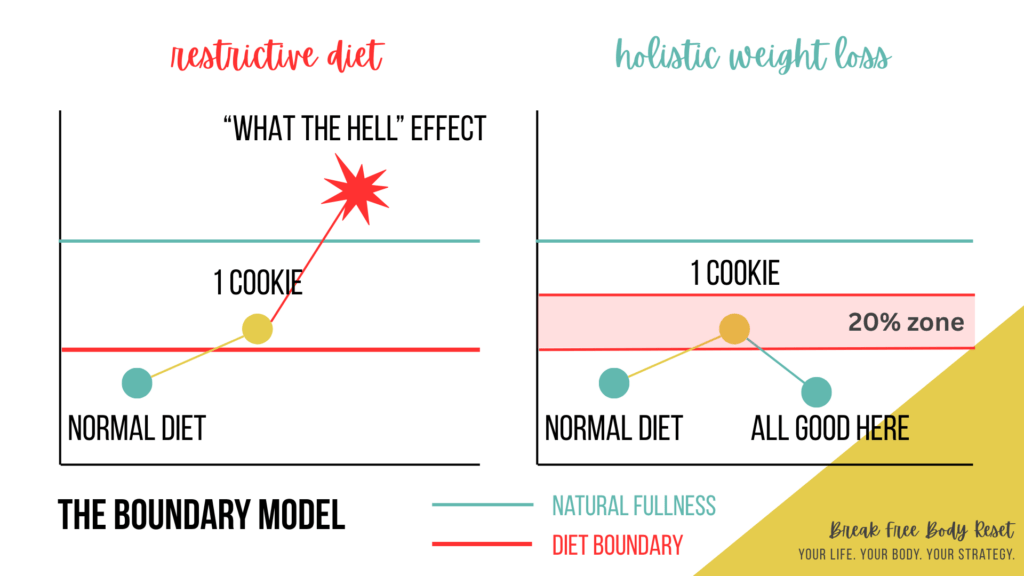
Here’s how it works: restrictive dieters tend to set a mental “diet boundary”, a self-imposed line for what and how much they’re allowed to eat, that sits below their body’s natural point of fullness. As long as they stay under that line, eating feels controlled. But the moment something pushes them past it, a biscuit, a bigger portion than planned, a “bad” food, the boundary itself stops doing any work.
Researchers found that once restrained eaters cross their self-imposed limit, they often go on to eat well past the point of genuine fullness, sometimes considerably more than someone who wasn’t dieting at all would eat in the same situation. The rule doesn’t bend a little. It breaks completely, and the “what the hell, I’ve already blown it” logic takes over.
This is genuinely useful to understand, because it reframes the whole pattern. It isn’t a character flaw, and it isn’t proof you “can’t control yourself around food.” It’s a fairly predictable mechanical consequence of setting a rigid line with no room either side of it. Strict rules don’t just risk being broken, they’re structurally set up to produce an outsized reaction the moment they are.
The way out isn’t more discipline, or a stricter boundary next time. It’s a framework with room in it for real life, one where a single higher calorie meal is just a meal, and a missed workout just a single missed workout, not a crossed line that justifies abandoning the rest of the day, the week, or the whole approach.
That’s the main reason we encourage using the 80/20 Pareto principle to guide our eating and movement choices. So 80% of the time, you eat and move in a way that feels good and right for your body. And 20% of the time, not so much, to allow for unexpected changes, social life and just normal real life. Without guilt or judgement.
5 Reasons Why Weight Loss Feels So Hard
Self-compassion: the actual antidote to the spiral
Why do we use the 80/20% framework? Well, if the boundary model explains why one slip tends to snowball, there’s an equally well-studied finding on what stops that snowball in its tracks, and it isn’t willpower.
In a controlled study, researchers gave a group of women a food “preload” designed to feel like a diet-breaking moment, then guided half of them through a brief self-compassion exercise (essentially: acknowledging the moment kindly, without harsh self-judgment) before offering a bowl of sweets to eat freely from.
The women who received the self-compassion prompt ate significantly less afterwards than those who didn’t, particularly among women who normally felt the most guilt around eating. Being kind to themselves in the moment, rather than critical, short-circuited the very spiral the boundary model predicts.
This tends to surprise people, because our instinct after a slip is usually to clamp down harder, right? Stricter rules, more guilt, a firmer resolve to “not let that happen again.”
Well the research suggests that’s precisely the response most likely to backfire. Self-criticism keeps you locked inside the all-or-nothing frame that caused the overeating in the first place. A brief, genuine moment of “that happened, it’s fine, I’ll just carry on” does more to protect the rest of your day than an internal telling-off ever will.
I want to be clear that this isn’t about lowering your standards or “letting yourself off the hook.” It’s a specific, evidence-backed response to a specific, well-documented behavioural trap, and it happens to be the response that actually produces less overeating, not more.

Temporary diets produce temporary results
This follows naturally from everything above, but it’s worth saying in plain English:
A diet with a start date and an end date will, almost by definition, produce a result that also has a start date and an end date.
Severe restriction pushes the body into the kind of hormonal rebound described above, and it usually can’t be maintained indefinitely, because it was never designed to be a permanent way of eating. Once the diet ends and old habits return (often alongside a body that’s now hungrier than before), the weight tends to return too.
This isn’t a mystery. It’s the entirely predictable outcome of a temporary strategy applied to a permanent goal.
It’s worth sitting with that phrase for a moment: a permanent goal. Almost nobody wants to lose weight for five, eight or twelve weeks. The actual goal, whether it’s said out loud or not, is usually something more like “I want to feel comfortable in my body for the rest of my life.” Matching a permanent goal with a temporary tool was always going to produce a temporary result, no matter how well the diet weeks themselves went.
Habits beat motivation
Motivation is a wonderful spark, but it’s a terrible long-term strategy, because it naturally comes and goes. Habits are different: once a behaviour becomes automatic, it no longer needs willpower to happen.
Research on habit formation has found that turning a new behaviour into something automatic takes, on average, around 66 days of consistent repetition, and for many people, considerably longer, particularly for more complex behaviours. That’s genuinely useful to know, because it explains why a habit often still feels effortful at three weeks in, and why giving up around that point (a very common point to give up) means stopping right before it was about to get easier, not because the approach wasn’t working.
This is also why crash diets and habits are almost opposites:
A crash diet asks for maximum effort for a short, defined period.
A sustainable habit asks for much smaller effort, repeated for long enough that it stops requiring effort at all.
Why Break Free Body Reset focuses on lifestyle rather than dieting
Put all of the above together, and the reason for this approach becomes fairly obvious:
+ if restriction creates rebound,
+ if rigid rules are mechanically set up to produce a “what the hell” spiral the moment they’re broken,
+ if self-criticism makes that spiral worse rather than better,
+ if temporary diets produce temporary results,
+ and if lasting change comes from habits rather than bursts of motivation,
= then the entire premise of “diet hard for 12 weeks and hope it sticks” is working against you before you’ve even started.
Break Free Body Reset is built around the opposite premise: gradual, sustainable shifts in how you eat, move and think, layered in slowly enough to actually become automatic, built with flexibility rather than rigid boundaries, and with room made for a kind, matter-of-fact response to the inevitable off days, rather than a self-critical one. It’s a slower promise than a crash diet makes. It’s also, based on everything above, a far more honest one.
If you’ve ever asked yourself “Why do I keep regaining the weight I lost?” before, that doesn’t say anything about your discipline or your worth. It simply says that the tool didn’t match the biology, the psychology or the timeline.
That’s a solvable problem, and it starts with understanding what actually creates lasting change.
5 Reasons Why Weight Loss Feels So Hard
And what to do about it
References
“Obesity and Hormones: Why Weight Gain May Be Inevitable,” MedCentral, citing behavioural weight loss maintenance data — https://www.medcentral.com/endocrinology/obesity/long-term-hormonal-metabolic-adaptations-weight-loss-0
Sumithran P, et al. “Long-Term Persistence of Hormonal Adaptations to Weight Loss,” New England Journal of Medicine (2011) — https://www.nejm.org/doi/full/10.1056/NEJMoa1105816
Lally P, van Jaarsveld CHM, Potts HWW, Wardle J. “How are habits formed: Modelling habit formation in the real world,” European Journal of Social Psychology (2010) — https://onlinelibrary.wiley.com/doi/10.1002/ejsp.674
Herman CP, Polivy J. “A Boundary Model for the Regulation of Eating,” Psychiatric Annals (1983), and subsequent research on the “disinhibition” or “what the hell” effect — https://www.ncbi.nlm.nih.gov/pmc/articles/PMC7096476/
Adams CE, Leary MR. “Promoting Self-Compassionate Attitudes Toward Eating Among Restrictive and Guilty Eaters,” Journal of Social and Clinical Psychology (2007) — https://guilfordjournals.com/doi/10.1521/jscp.2007.26.10.1120