
is my metabolism broken?
“Is my metabolism broken?”
How many times have you heard somebody wonder, as if a “broken metabolism” is a confirmed diagnosis rather than a guess? Or even asked yourself? And I totally get why it feels that way: you’re doing roughly what you’ve always done, and the results have changed. Something must be wrong, surely, right?
Here’s what I want to unpack today, properly, with the actual research behind it: what metabolism is, why it genuinely does change with age, and why “broken” isn’t a word that applies here, even when things feel frustratingly different.
What metabolism actually is
Let’s start with the basics, because this word gets thrown around constantly without much explanation.
Your metabolism is simply the sum of every chemical process your body runs to keep you alive and functioning: breathing, pumping blood, digesting food, repairing tissue, thinking, moving.
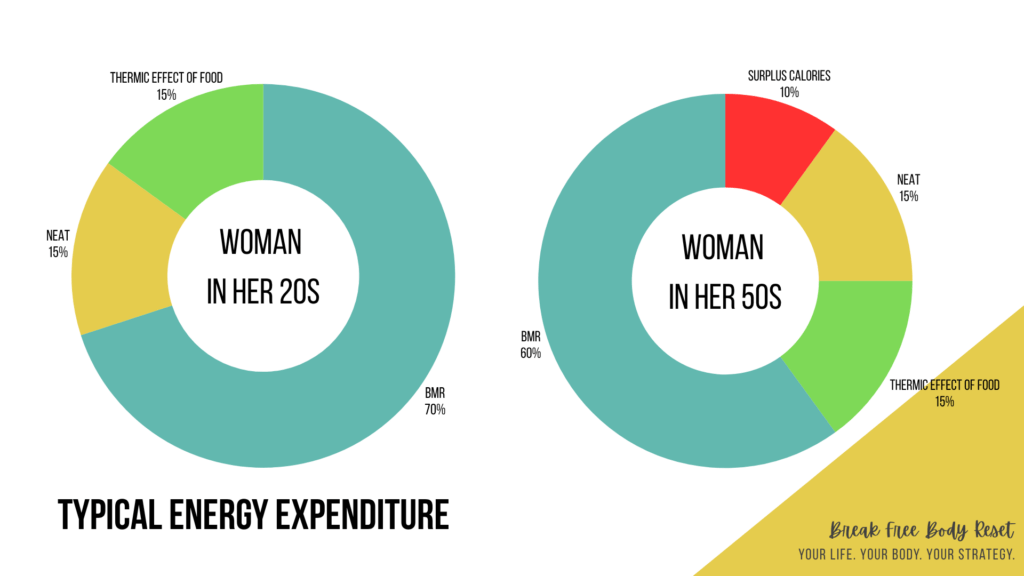
The energy this all requires is your total daily energy expenditure, and it’s made up of a few pieces:
- Basal metabolic rate, the energy your body burns just existing, roughly half to two thirds of your total daily energy use.
- The thermic effect of food, the energy spent digesting what you eat.
- Non-exercise activity, all the incidental movement of daily life: fidgeting, standing, walking to the kettle.
- Exercise, whatever structured movement you do on top of all that.
The lead actor here is muscle. Muscle is the single biggest driver of that basal number. The more metabolically active tissue (= muscle) you carry, the more energy your body needs at rest. This is the thread that runs through almost everything below.
5 Reasons Why Weight Loss Feels So Hard
And what to do about it
Why it changes
Metabolism does change over a lifetime, genuinely and measurably. But the story is more specific, and honestly more reassuring, than most people expect.
One of the largest studies ever done on this question used the doubly labelled water method (the gold standard for measuring real world energy expenditure) in over 6,400 people worldwide, ranging from eight days old to 95 years old.
The researchers found that once energy expenditure is adjusted for body composition, adulthood contains one long, stable plateau. Total daily energy expenditure remains essentially steady from age 20 to 60, even through pregnancy. Which is pretty wild if you ask me.
It’s only after 60 that a genuine decline begins.
Read that again, because it matters: for most of the years women worry about their metabolism “slowing down,” the underlying engine, adjusted for body composition, isn’t actually the problem.
So what is changing?
The body composition itself. That is, our ratio of fat (essential fat, needed for basic bodily functions, and stored fat, dem’ extra energy reserves) and lean mass (everything that is not fat, such as muscles, bones, organs, and body water). From our late thirties onward, and accelerating through the menopause transition, we naturally lose muscle mass, with postmenopausal muscle mass declining by roughly 0.6% a year (see this post for actual numbers, a bit of an eye-opener…).
Since muscle drives your basal metabolic rate, losing it means your total number of required calories goes down, not because your metabolism has malfunctioned, but because you’re carrying less of the tissue that demands the fuel.
Add to that a decade of quietly reduced daily movement, because the kind of stuff that keeps us moving changes over time (think busy toddlers compared to late-night deadlines), and you get a very ordinary, very explainable drop in how many calories your body needs. No permanent damage here.
Why “broken metabolism” isn’t a diagnosis
I want to be blunt about this, because I think what we hear and say causes real harm: “broken metabolism” isn’t a medical diagnosis. It’s not a condition your doctor can test for, confirm or fix.
Now, some conditions can genuinely slow down your metabolism: specific, diagnosable disorders like hypothyroidism, or certain medications, and those are absolutely worth investigating with a doctor if your symptoms feel sudden or severe.
But for the vast majority of women who feel their metabolism has “stopped,” what’s actually happened is a combination of the very ordinary, very research-backed factors above: less muscle, less daily movement, and often, a history of restrictive dieting that’s made the body understandably more cautious with its energy (more on that in this post).
None of that involves damage of any sort. It’s biology responding sensibly to change, which is a very different thing.
This distinction matters hugely, because “broken” implies this needs fixing. And since this is not a medical diagnosis, there is no easy medical fix. So when we think we are in some way “broken”, we start to feel like there’s nothing we can do.
But if we view our metabolism as “adapted over time, for specific reasons”, it implies exactly the opposite.
Muscle: the biggest lever you actually have
If there’s one single thing to walk away with from this whole article, it’s this: muscle is the most powerful, most modifiable lever on your metabolic rate that you have direct control over.
Strength-based movement, even in short, simple sessions, signals your body to maintain and build muscle rather than lose it. This isn’t about becoming a bodybuilder. Two or three short sessions a week, using bodyweight, bands or light weights, genuinely moves the needle over months.
Oh, and don’t worry, women don’t “bulk up”. Even the majority of hard-core women athletes are anything but bulky.
Daily movement: the quiet multiplier
Beyond structured exercise, the incidental movement of an ordinary day (walking, standing, doing the garden, taking the stairs) adds up to a meaningful chunk of daily energy burn, often more than people expect. If life has gradually become more sedentary over the years, rebuilding this piece doesn’t require a gym membership. It requires noticing where movement has quietly disappeared, and putting a little of it back.
Notice your walking pace and ask yourself: am I walking slower than I used to? Could I be walking faster? Right there is your cue to increase your energy expenditure, all the while regaining minutes of your day!

Eating enough protein
This one can come as a surprise: under-eating protein specifically, even while eating “enough” calories overall, accelerates muscle loss, particularly during any period of weight loss. A randomised controlled trial in older adults found that a higher protein diet (around 1.3g per kilogram of body weight) preserved significantly more fat-free mass (muscle) during a weight loss programme than a standard protein intake did, especially when paired with resistance exercise.
Other research points to roughly 25 to 30g of protein per meal as a genuinely useful target for maintaining muscle as we age. If you’ve been eating “light” in a way that’s also light in protein, that’s very likely working against the exact thing you’re trying to protect.
On a side note, unless you suffer with an existing kidney condition, eating more protein won’t cause any harm; this myth has long been debunked.
Better sleep
Last on this list, but far from least. Poor sleep doesn’t just make you tired, it shifts the hormones that regulate hunger and fullness, with even short-term sleep restriction shown to raise hunger hormone levels and increase next day appetite in controlled studies. Oh, and increase your insulin response by 30% (remember insulin? your storage hormone? we do not want this one to increase).
Combine that with the muscle loss that chronic under-sleeping and stress can accelerate, and sleep stops looking like a “nice to have” and starts looking like a genuine metabolic lever, right alongside muscle, movement and protein.
so is your metabolism actually broken?
Your metabolism isn’t broken. It’s responding, sensibly and predictably, to less muscle, less daily movement, probably less protein, and often less sleep, layered on top of the natural, well-documented changes of ageing.
None of that is a life sentence. Every single piece of it is something you can influence, starting this week. No magic metabolic fixing.
Now I’m not trying to downplay the “broken metabolism” story. This story is actually a much bigger one, because it hands the steering wheel back to you. It gives you agency over something you thought was permanently and terminally broken. And allows you to tweak your metabolism back to its glorious youthful efficiency.
5 Reasons Why Weight Loss Feels So Hard
And what to do about it
References
Pontzer H, et al. “Daily energy expenditure through the human life course,” Science (2021) — https://www.science.org/doi/10.1126/science.abe5017
“Association between menopause-related symptoms and muscle mass index among perimenopausal and postmenopausal women,” NCBI — https://www.ncbi.nlm.nih.gov/pmc/articles/PMC12325020/
Verreijen AM, et al. “Effect of a high protein diet and/or resistance exercise on the preservation of fat free mass during weight loss in overweight and obese older adults,” Nutrition Journal — https://www.ncbi.nlm.nih.gov/pmc/articles/PMC5294725/
Scientific American, “How Slight Sleep Deprivation Could Add Extra Pounds” — https://www.scientificamerican.com/article/sleep-deprivation-obesity/“Is this just hormones?” is also one of the first questions I get, usually asked with a mix of hope and frustration. Hope, because a hormonal explanation for weight gain feels like it might come with a tidy fix. Frustration, because so many women have already tried the tidy fix and it hasn’t fully worked.